[The original German title, „Lebens(t)räume„, is a play on words combining Lebensräume („living spaces“) and Lebensträume („dreams in life“). While this wordplay cannot be translated directly into English, it beautifully expresses the idea behind these additional cards: every dream needs a place where it can grow.]
A few days ago, I launched my online Kipper card reading. Some of you may already have noticed that I took the artistic liberty of expanding the traditional Kipper deck by adding nine additional cards. These are:
No. 37 Forest
No. 38 Starry Sky
No. 39 Vormärz (German Pre-Revolutionary Era, 1815-1848)
No. 40 Signpost
No. 41 Narrow Alley
No. 42 Marketplace
No. 43 Gaming Table
No. 44 Orangery
No. 45 Study
Why Did I Add Nine Additional Kipper Cards?
The Kipper cards originated during the Biedermeier period (1815–1848), an era strongly shaped by a retreat into private life. Political censorship, the Restoration following the Napoleonic Wars, and years of unrest across Europe left many people longing for peace, stability, and a well-ordered world. As a result, harmony, family life, domestic happiness, and security became central values of the time.
It is therefore no surprise that the Kipper cards themselves are remarkably simple and down-to-earth. They feature numerous people cards, and their illustrations clearly reflect a world in which everyday life was centred around the home and family. With the exception of a few cards representing public authorities or official institutions—such as No. 22 Military Person, No. 23 Court, No. 29 Prison, and No. 30 Court Official—the traditional deck focuses almost entirely on the pleasant and less pleasant events of everyday life.
Even the Living Room has its own card. This is no coincidence. During the Biedermeier period, the living room became the heart of middle-class family life. One could therefore say that the visual language of the Kipper deck deliberately concentrates on situations that take place inside the home or in its immediate surroundings.
Our world, however, has changed dramatically since then. We live in a different age, we are connected in entirely new ways, and we face challenges that the creators of the original Kipper deck could never have imagined. This inspired me to expand the traditional deck—carefully and respectfully—without sacrificing its historical character or its unique charm.
My intention was never to modernize the Kipper cards. Instead, I asked myself a simple question:
What might the deck look like today if its original creators had designed five or even ten additional cards?
With this idea in mind, I deliberately avoided abstract concepts and modern buzzwords. Instead, I chose only motifs that would have fitted naturally into the Biedermeier period while preserving the distinctive spirit of the original deck. The only thing that changes is the perspective. Rather than focusing exclusively on the home itself, the additional cards gently expand the world around it and the places that shaped everyday life.
Each of these nine cards broadens the original world of the Kipper deck just a little—without ever leaving the Biedermeier period behind. That is precisely why the journey does not begin with a modern scene, but with something that was just as familiar to people then as it is today:
No. 37 Forest
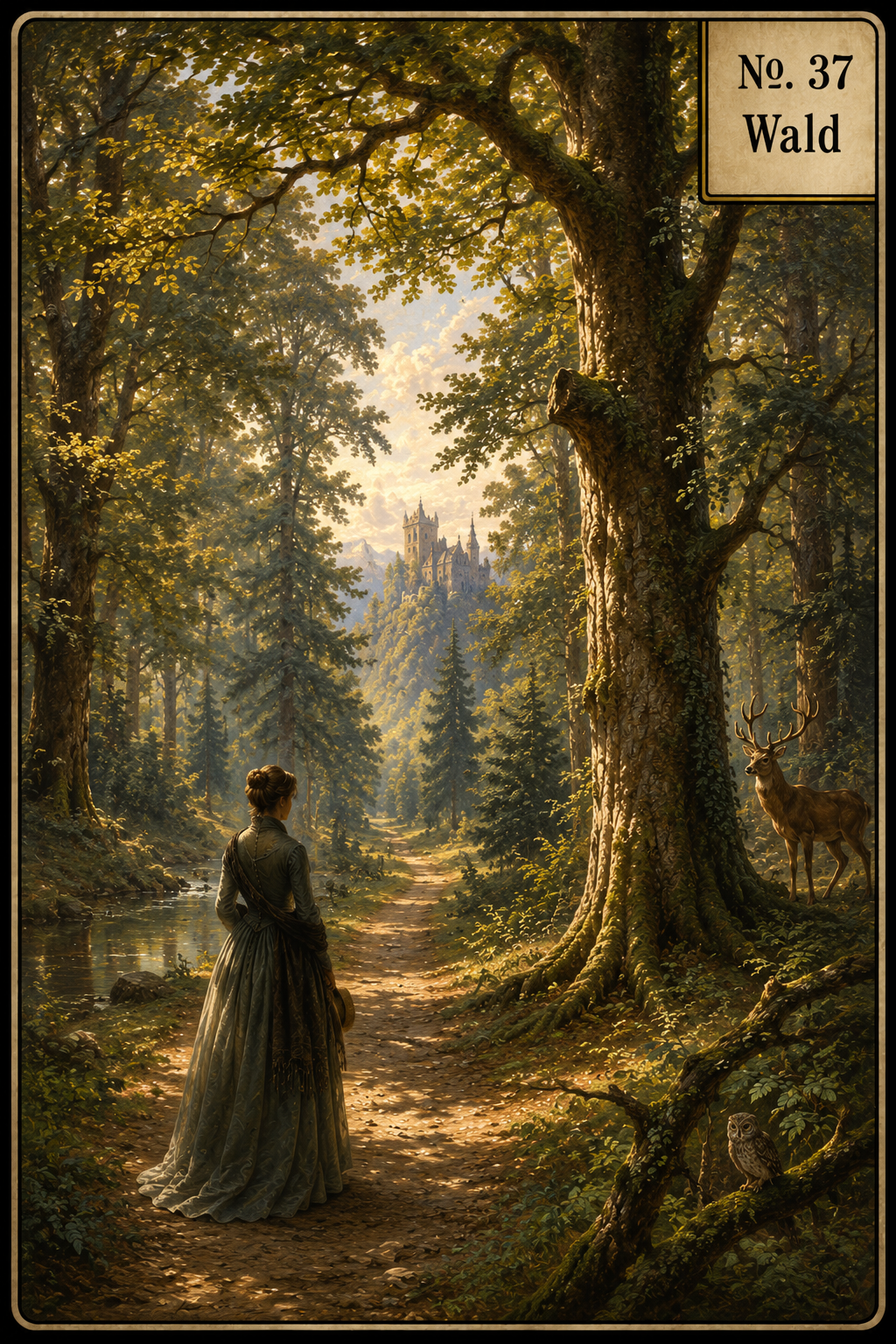
Although family was considered the highest ideal during the Biedermeier period, nature also played an important role as a place of rest, reflection, and retreat. While the original 36 Kipper cards feature plenty of greenery, they do not include a card dedicated entirely to the forest.
Whereas the Romantic movement often portrayed forests as mysterious, enchanted, and almost mystical places, the Biedermeier period viewed nature quite differently. It was seen as a peaceful and harmonious environment that offered calm, order, and a sense of security. Walks in the countryside became one of the favourite leisure activities of the growing middle class, and the forest was regarded as a place for relaxation, quiet contemplation, and renewal. Artists such as Carl Spitzweg and Ferdinand Georg Waldmüller beautifully captured this atmosphere in many of their paintings.
The Forest card reflects precisely this idea. It represents a close connection with nature, the need to withdraw from everyday life, rest, and a return to what truly matters. At times, it simply invites us to leave the noise of daily life behind for a while and rediscover strength, clarity, and inner peace in the quiet of nature.
No. 38 Starry Sky
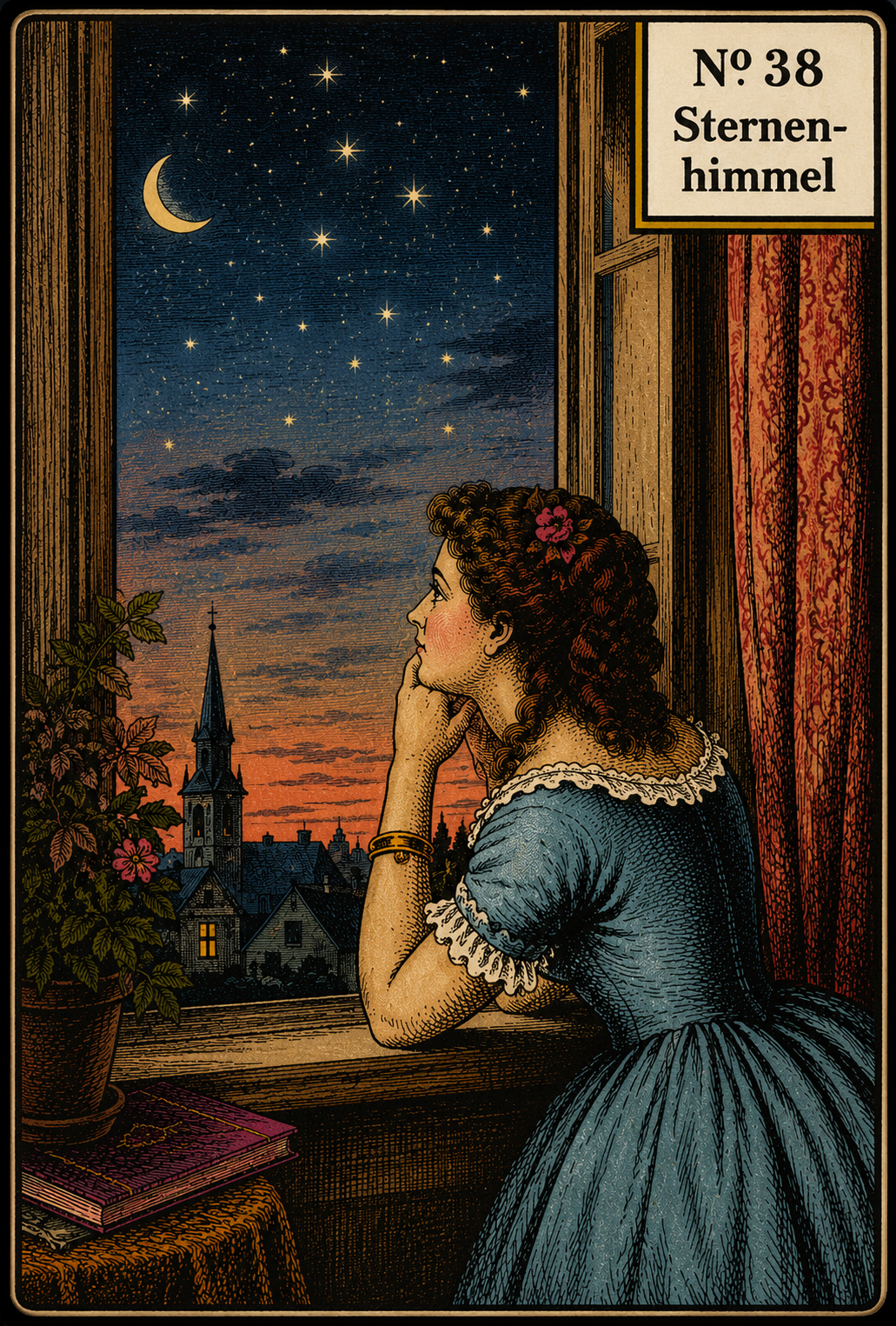
By the time of the Biedermeier period, astrology had largely lost its standing within academic and scientific circles and was often dismissed as superstition. The centuries-old bond between astrology and astronomy had long since been broken. Nevertheless, interest in the stars and their symbolic meaning remained alive among ordinary people. Popular almanacs and rural traditions helped preserve at least the basic principles of astrological knowledge.
The starry sky therefore represented far more than a beautiful natural spectacle. While the stars had once been consulted primarily to advise rulers and kings, attention gradually shifted toward the individual. Gazing at the night sky became an expression of a personal search for meaning and a way of reflecting on one’s own place within the greater whole.
For this reason, the Starry Sky card represents far more than astrology alone. It symbolizes inspiration, vision, trust in a higher order, and the ability to see life from a broader perspective. At times, it helps us recognize connections that remain hidden in everyday life and encourages us to understand situations from an entirely new point of view.
No. 39 Vormärz (German Pre-Revolutionary Era, 1815–1848)
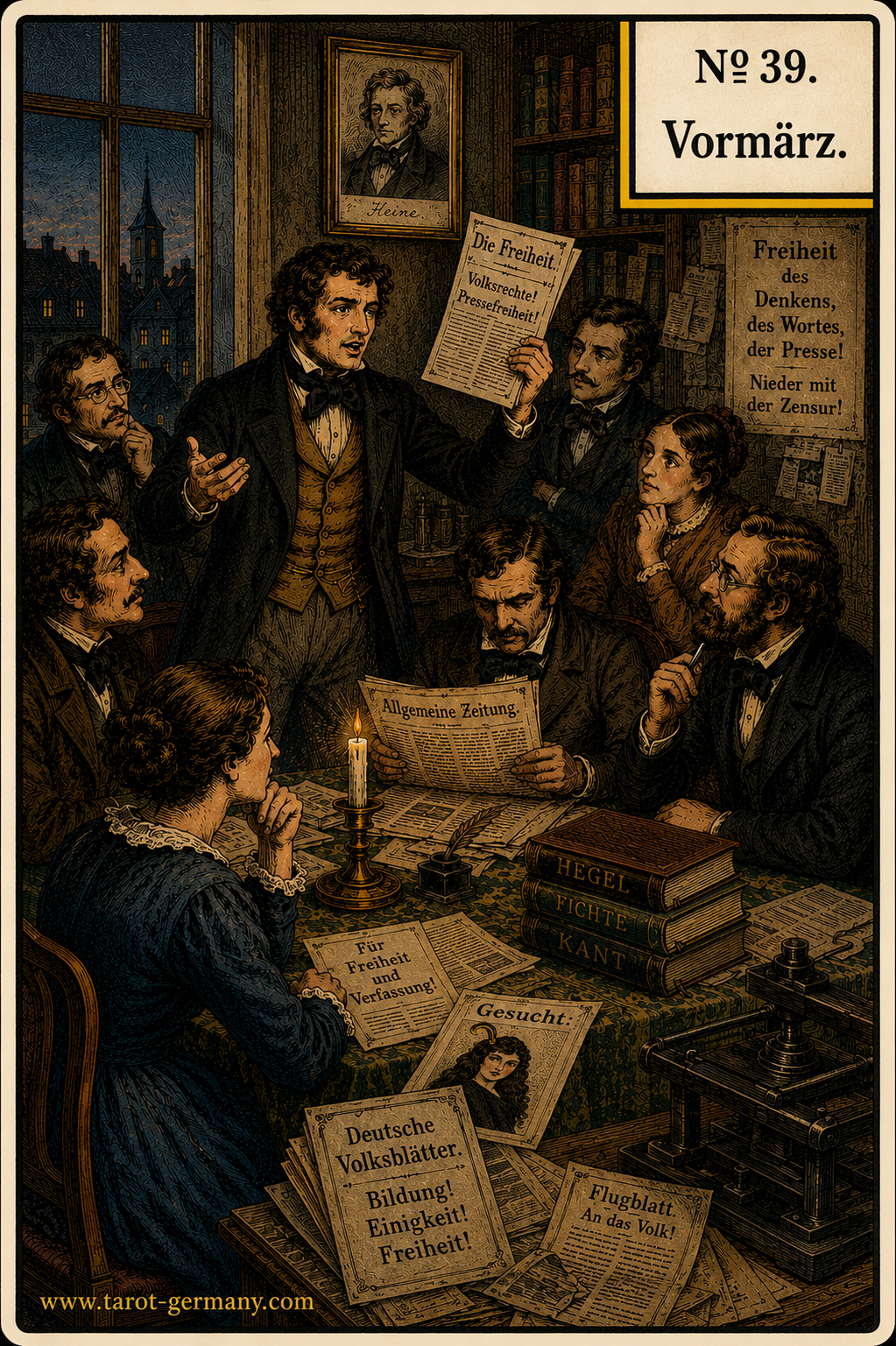
For many people, the Biedermeier period immediately brings to mind cosy living rooms, the paintings of Carl Spitzweg, and a quiet, family-centred way of life. Indeed, domesticity, harmony, and the retreat into private life became defining characteristics of this era. Yet another movement emerged at the very same time—one that deserves just as much attention: the Vormärz.
While much of the conservative middle class responded to political censorship and repression by retreating into the privacy of home and family life, a growing movement of writers, intellectuals, and political thinkers began advocating for freedom, civil rights, and a democratic nation-state.
The representatives of the Vormärz called for freedom of speech and of the press, an end to the growing social injustices brought about by industrialization, and greater political participation for ordinary citizens. They opposed censorship and arbitrary rule, helping to lay the intellectual foundations for the German Revolution of 1848. Among the best-known representatives of this movement was the poet Heinrich Heine. This important chapter of German history is barely reflected in the traditional Kipper deck. Nevertheless, I felt it deserved a place among the additional cards. That is why I deliberately chose the historical term Vormärz as the title of this card, even though it may not be familiar to many readers outside the German-speaking world.
The Vormärz card represents new beginnings, renewal, and the courage to think beyond established boundaries. It announces change without depicting the actual turning point itself. New ideas begin to emerge, old structures gradually lose their certainty, and the first signs of a coming transformation become visible.
No. 40 Signpost
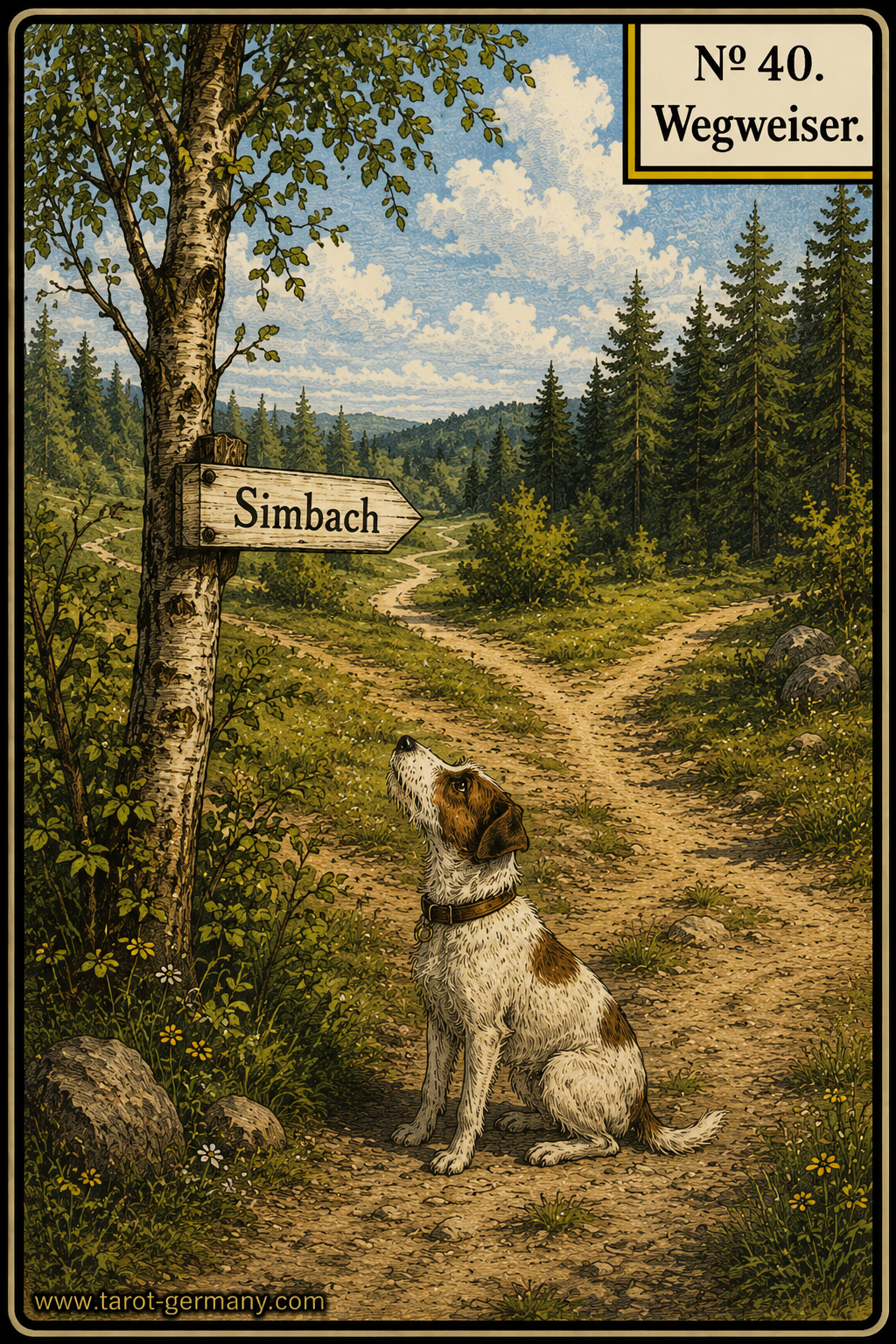
The idea of setting out on a journey already appears in the traditional Kipper deck. No. 10 A Journey represents travel or an upcoming change. No. 23 Court deals with an important decision, while No. 35 A Long Road reminds us that some goals require more time, patience, and preparation than we may have expected.
What I felt was missing, however, was a card that captures the moment before the journey begins—the moment of orientation. A card that reminds us we still have choices to make, or that reveals a new path we may not have noticed before.
That is how No. 40 Signpost came into being. It represents guidance, freedom of choice, and new perspectives. Sometimes it points toward a change in direction; at other times, it simply confirms that we are already on the right path. It can also indicate that a confusing situation is gradually becoming clearer, allowing the way ahead to reveal itself step by step.
No. 41 Narrow Alley
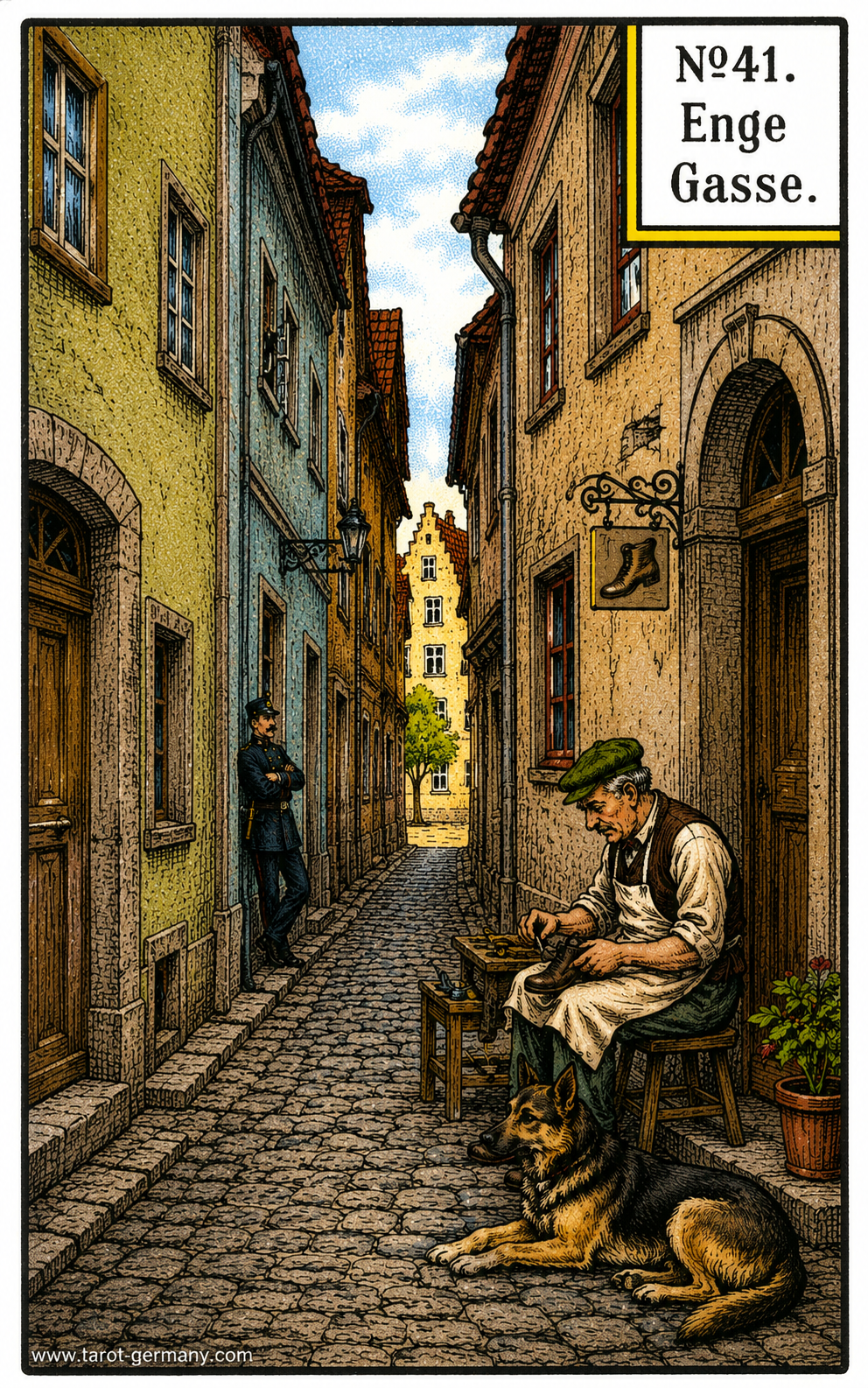
Perhaps it really was a moment of inspiration. One day, while walking my dog and thinking about possible additions to the Kipper deck, the image of a narrow alley suddenly appeared in my mind. I could clearly picture rows of simple, well-kept houses standing close together, separated only by the narrow lanes that wound their way between them.
When I began researching the subject afterwards, I discovered that this image was remarkably accurate. In many places, towns during the Biedermeier period still followed their medieval street layouts, where narrow alleys formed a natural part of everyday life. It was not until the middle of the nineteenth century that many cities were extensively redesigned, with wider streets and more open spaces.
Life in these alleys was lively and bustling, creating an interesting contrast to the peaceful image so often associated with the Biedermeier period. From early morning onwards, the streets were full of activity. Horse-drawn carts rumbled across the uneven cobblestones, merchants loudly advertised their goods, and much of everyday life took place right outside people’s front doors. Women knitted or washed laundry, while shoemakers, tailors, and other craftsmen worked in front of their homes or beside open windows. In many ways, the alley became an extension of the living room.
Yet these streets also had their less pleasant side. Open gutters carried rainwater and wastewater, often producing unpleasant smells. Livestock was kept in the courtyards, carriages squeezed through the narrow passages, and the closely packed buildings allowed very little sunlight to reach the streets below.
For this reason, the Narrow Alley card represents situations in which our freedom of movement or our options are temporarily limited. At times, we may feel confined or sense that other people are getting too close. At the same time, the card also represents familiarity, everyday routines, and established patterns that cannot easily be left behind. Most importantly, however, it reminds us that every narrow alley has an exit. The limitations we experience are usually only temporary—and more often than not, a new path is waiting just around the corner.
No. 42 Marketplace
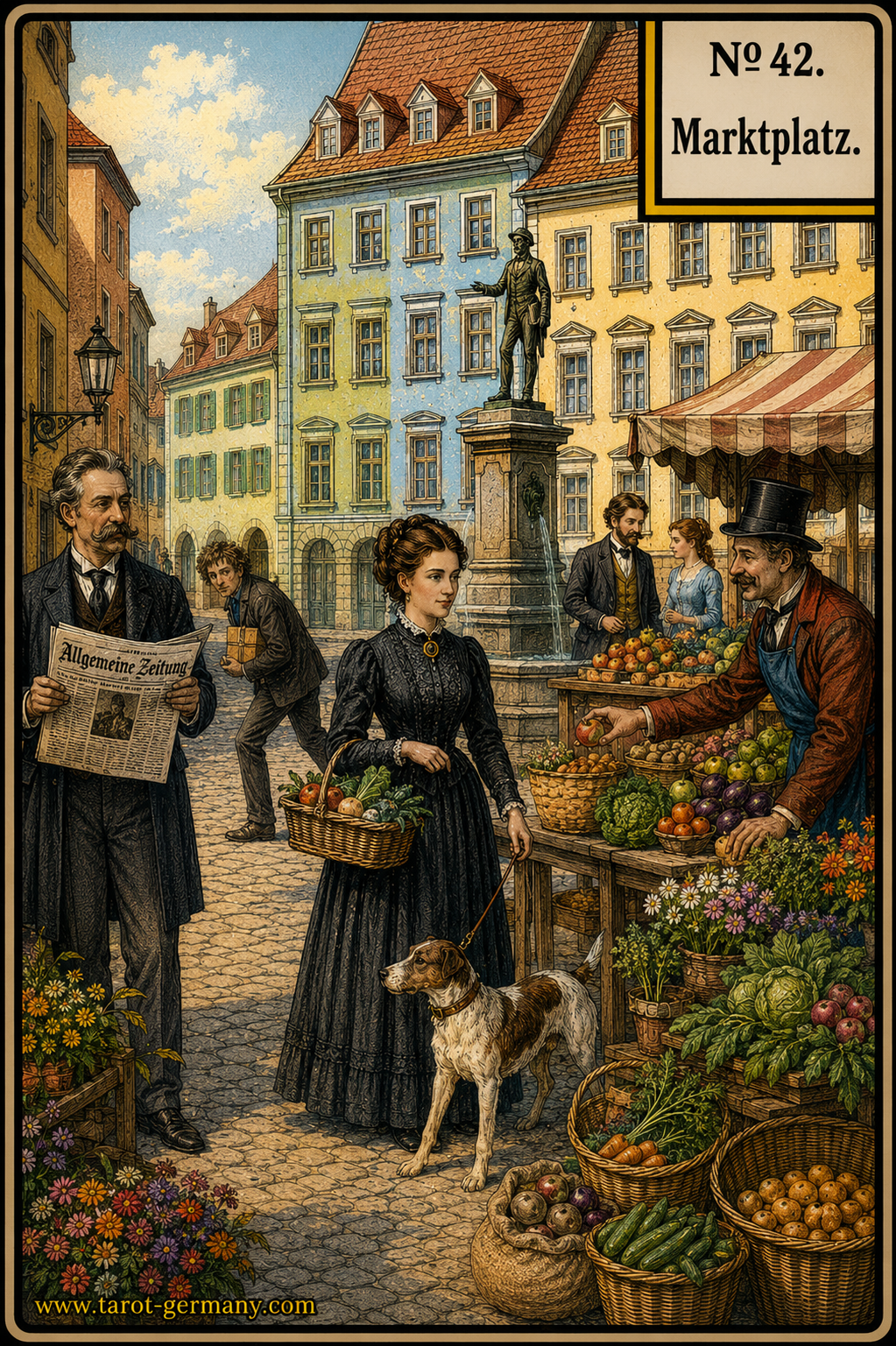
Although the strict political censorship of the Metternich era encouraged many people during the Biedermeier period to withdraw into private life, the marketplace remained the vibrant centre of everyday public life. Here, people bought and sold goods, exchanged news, and maintained social contacts. Large political gatherings were rare—those ideals are represented in my deck by No. 39 Vormärz.
The traditional Kipper card No. 34 Occupation represents one’s profession and daily work. No. 30 Court Official may also point to advisory or public service professions. The Marketplace card, however, focuses on commerce, buying and selling, business relationships, and encounters that take place in the public sphere.
While No. 7 Pleasant Letter usually brings personal messages or private news, the Marketplace refers to public information, rumours, or developments that affect many people. At the same time, it may indicate new contacts, business opportunities, networking, or an active social life.
No. 43 Gaming Table
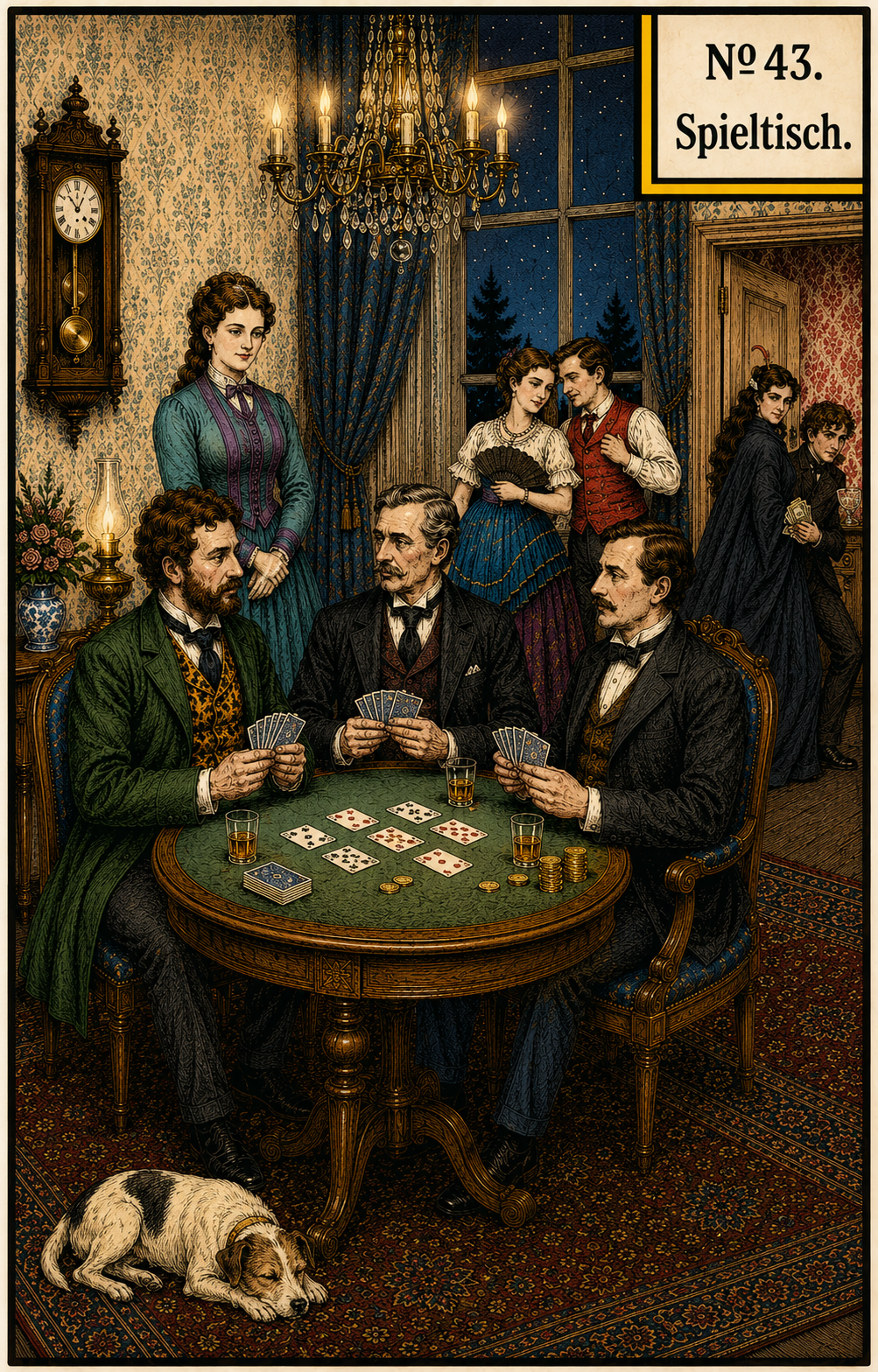
The gaming and tavern culture of the Biedermeier period formed an important part of everyday social life. People did not gather only in their own living rooms, but also in inns, cafés, and wine taverns. These places became semi-public meeting spots where friends met to talk, play games, and enjoy each other’s company. Card games, chess, and dice games were among the most popular pastimes of the era. Specially designed gaming tables reflected this enthusiasm. With their ingenious, space-saving construction, they provided the perfect setting for lively conversations, exciting games, and a good glass of wine. Today, original Biedermeier gaming tables are highly sought-after collectors‘ pieces.
For me, it therefore seemed only natural to include a Gaming Table in my Kipper deck. The card brings together many familiar characters: the Main Female Person, the Main Male Person, the couple from No. 3 Marriage, the Good Gentleman, and several other guests gathered around the table, while the ladies quietly observe the scene from the background. Yet wherever games are played, not everything is always fair. That is why the False Person from No. 8 and the Thief from No. 24 can also be seen quietly slipping out through the doorway—a small detail that attentive observers may discover.
While the traditional Kipper deck illustrates many aspects of domestic life, it lacked a place where people from different walks of life could meet informally. Whereas No. 4 Meeting represents social gatherings in general and No. 42 Marketplace symbolizes public life, the Gaming Table is dedicated to friendship, leisure, and companionship within a smaller circle. It was precisely this missing piece that I wanted to add.
The Gaming Table card represents friendship, entertainment, and enjoyable moments away from everyday responsibilities. It points to social encounters, leisure time, and shared pleasures, while gently reminding us not to be carried away by carelessness or unnecessary risks.
No. 44 Orangery
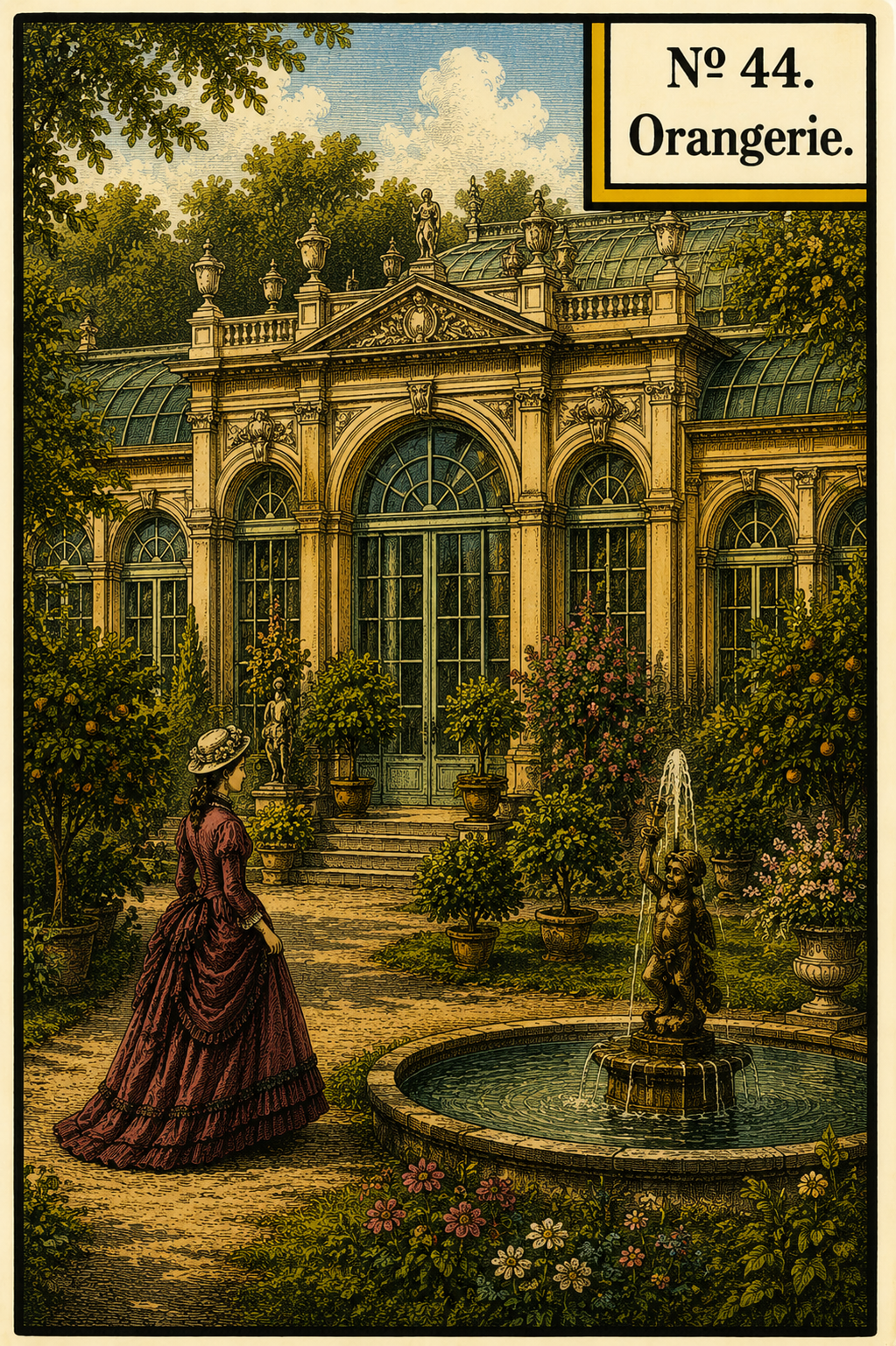
By the time of the Biedermeier period, orangeries were already beginning to lose some of their former importance. Originally, they had been built to protect delicate citrus trees and other exotic plants during the winter months. As the middle class grew in prosperity, however, private gardens and smaller greenhouses became increasingly common, and the great orangeries gradually fell out of fashion. Even so, they never lost their special fascination. More than simply places filled with magnificent plants, they became symbols of leisure, beauty, and the close relationship between people and nature.
The working title of this card was originally „Romantic Philosophy of Nature“. Later, however, I felt that the title was too abstract and decided against using it. Although the name changed, the underlying idea remained the same. „Romantic Philosophy of Nature“ was an important intellectual movement of its time, embraced by thinkers such as Goethe and Alexander von Humboldt, and based on the idea that all of nature is deeply interconnected.
While the natural sciences flourished during the Biedermeier period—especially botany, which was regarded as a refined and fashionable pursuit—the philosophy of Romanticism continued to shape the intellectual climate. People read Goethe and Novalis, and many were familiar with the idea that nature itself possesses a living spirit.
The language of flowers also played an important role during the Biedermeier era. Flowers served as a quiet means of communication, expressing emotions and messages that were often left unspoken. A rose symbolized love, forget-me-nots represented faithfulness and remembrance, while ivy stood for constancy and immortality. Readers who would like to explore this fascinating subject in greater depth will find a separate article on my website about the symbolism of flowers during the Biedermeier period 🇩🇪.
For this reason, the Orangery card represents joy in life, leisure, and an appreciation for life’s beauty. It encourages us to make time for rest, inspiration, and personal growth, while reminding us that everything is connected and that beauty often reveals itself when we take the time to look with care. Whereas No. 37 Forest represents nature in its untouched form, along with retreat, renewal, and well-being, the Orangery symbolizes nature shaped and cultivated by human hands—a place of refinement, tranquillity, and the conscious enjoyment of life’s beauty.
No. 45 Study
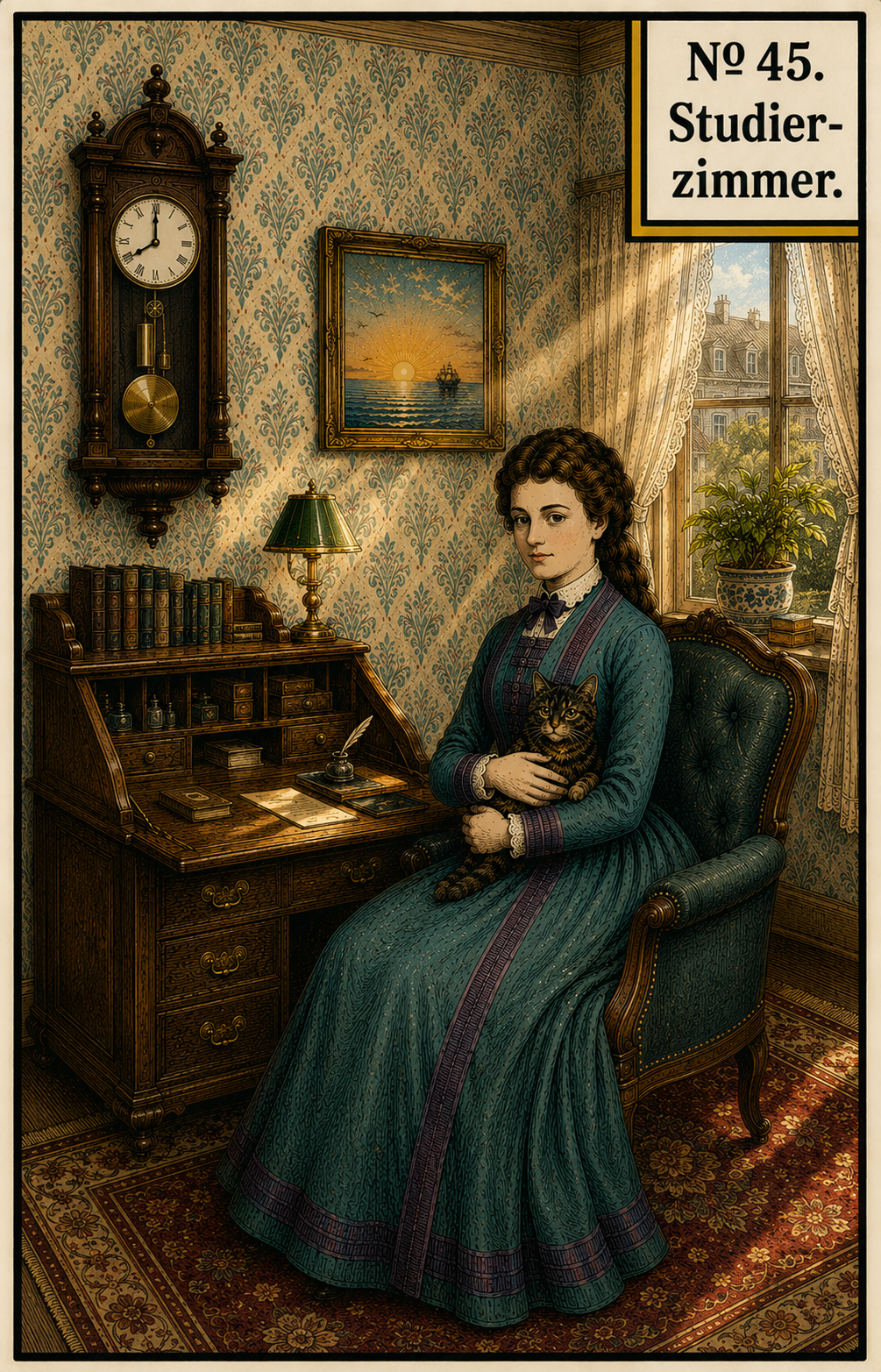
Although the term Biedermeier was long used as a synonym for narrow-mindedness and bourgeois conformity, one important aspect of this period should never be underestimated: its remarkable thirst for knowledge and education. Much of this intellectual life flourished within the home itself. It was therefore no coincidence that many middle-class households included a dedicated Study—a room that has become surprisingly rare today.
At the heart of the room usually stood a writing cabinet. Crafted from fine woods or finished with elegant lacquer, these beautiful pieces of furniture served as closed cabinets until the writing surface was folded down, revealing a practical workspace. Numerous small drawers and compartments provided room for letters, documents, and writing materials. It was here that people read, wrote, reflected, studied, and worked.
Originally, I considered creating a card called „Studio“, as art and creativity also played an important role during the Biedermeier period. But a studio would have represented only one aspect of this world. The Study, by contrast, brings many different pursuits together. It is a place for reading and writing, research and learning, art and science—in short, a room dedicated to intellectual growth.
While No. 7 Pleasant Letter represents everyday correspondence and No. 42 Marketplace symbolizes the exchange of information, the Study is devoted to deeper knowledge. It represents education, continuing learning, focused work, research, and important learning processes. At the same time, the card reminds us that genuine knowledge requires time, patience, and the willingness to explore a subject in depth.
Living Spaces – Living Dreams
I hope these nine additional cards blend harmoniously with the traditional Kipper deck and bring as much enjoyment as the original thirty-six cards. My hope is that they will also enrich the symbolic language and interpretive possibilities of the deck. Whether I have succeeded is ultimately for readers and Kipper enthusiasts to decide.
As I was finishing this project, one final thought came to me. These nine additional cards do more than introduce new places that were missing from the traditional Kipper deck. Each of them also tells the story of a dream. After all, every dream needs a place where it can grow. And sometimes, a single image on a card is enough to remind us of what our hearts have been longing for all along.
The Forest speaks of our longing for peace and tranquillity.
The Starry Sky reminds us to search for meaning and a sense of direction.
Vormärz inspires us to embrace freedom, renewal, and new ideas.
The Signpost encourages us to find our own path.
The Narrow Alley reminds us that every difficult passage eventually leads to an exit.
The Marketplace represents connection, communication, and new opportunities.
The Gaming Table celebrates friendship, shared laughter, and the joy of being together.
The Orangery invites us to appreciate beauty, leisure, and the quiet moments of life.
The Study reminds us that learning, curiosity, and intellectual growth are lifelong companions.
Which of these cards reflects your own living dream? I’d love to hear from you: susanne@tarot-germany.com